
On thinking small
And chasing something greater than yourself

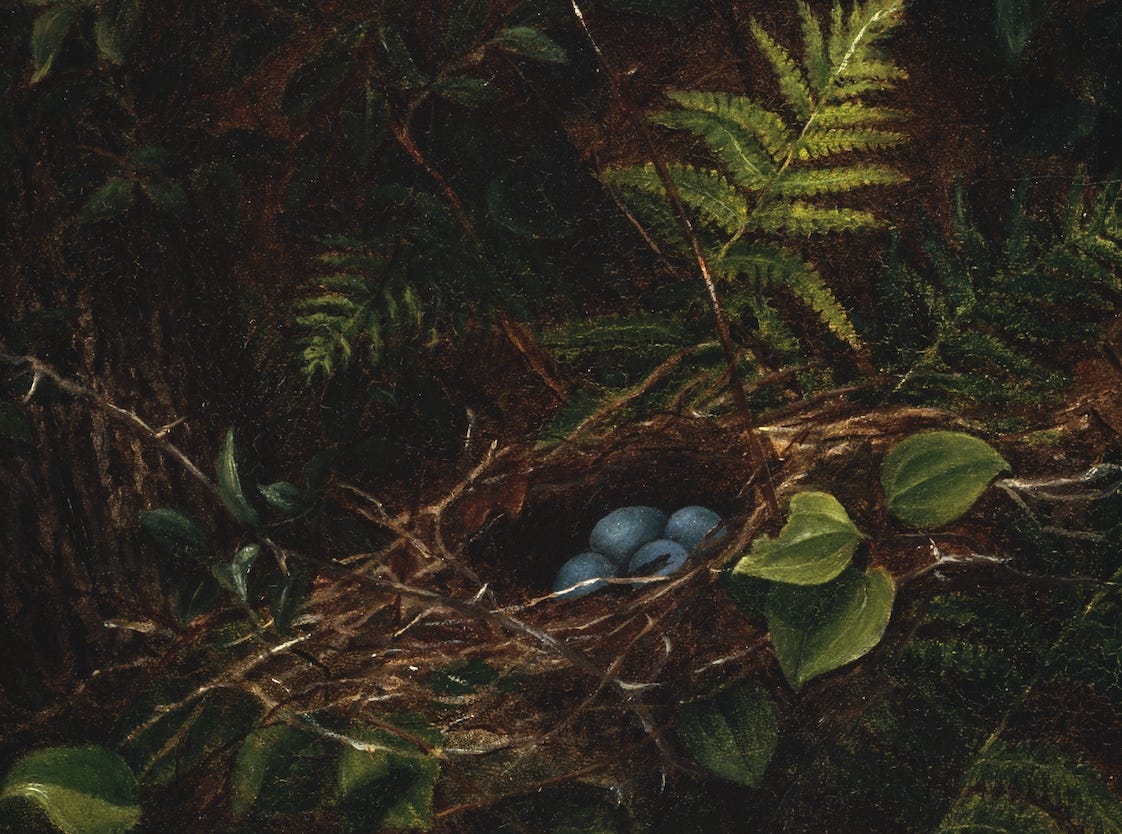
Here in high summer and with a book on the way this fall, I’ve found myself thinking about the birds—usually but not always robins—that dip into my sightline as I’m driving. They appear and vanish in a near instant, darting through the air into the dark recesses of a maple tree.
Season after season they do whatever it is they do to survive: fledging, feeding, mating, nesting, singing.
Noticing birds and writing about them is one way I have learned to live. Just as my mind might trace their winged path from tree to tree, my hand traces sentences across the page. Glimpses of birds fill the essays of my new book Rare Good. The title essay begins with a shock of bluebirds on a snowy back deck, their dazzling feathers against winter gray. Elsewhere owls hoot in the dark before dawn, a comfort and a kind of companionship on nights my young son, suffering from a chronic illness, cried and cried. Red-tailed hawks show up to snag squirrels. Poet Wallace Stevens’s blackbirds make an appearance in an essay about the autistic painter Dan Miller.
“Think small,” Richard Hugo advised aspiring poets in The Triggering Town, a book I devoured and took to heart when my mentor, novelist Patricia Henley, suggested I read it thirty years ago. Your obsessions will bring you the language you need, Hugo reassured me. The language itself will “validate and complete” your experience.
Think small.
The world is enormous. Think small.
One day in my first-year writing class last year, I made the mistake of thinking big. I shared an article from the Cornell Lab of Ornithology. “Nearly Three Billion Birds Gone Since 1970,” proclaimed the headline. A truly shocking number. The article’s opening paragraph bluntly stated the facts of the matter: “The first-ever comprehensive assessment of net population changes in the U.S. and Canada reveals across-the-board declines that scientists call ‘staggering.’ All told, the North American bird population is down by 2.9 billion breeding adults, with devastating losses among birds in every biome. Forests alone have lost 1 billion birds. Grassland bird populations collectively have declined by 53%, or another 720 million birds.”
Cornell Lab of Ornithology director John Fitzpatrick and study coauthor Peter Marr described this turn of events as, “A staggering loss that suggests the very fabric of North America’s ecosystem is unraveling.”
I thought such information might alarm my students. Might wake them up to what is at stake and why it matters that they learn to read and write and become powerful people. But if the article stirred anything in them, I couldn’t tell. By and large, they stared off into space or down at their notebooks or out the window, waiting for time to pass, for some happier thought to come along. In the back of the classroom, one young woman leaned over to another and showed her something on her phone—a text message, a silly video. They giggled together.
I should have known: There isn’t room in the mind for birds by the billions. Think small. One feather at a time.
If I try to teach that lesson again, I might tell them instead about how while out walking my dog on the town common yesterday, I saw a hawk lying dead on the side of the road, likely hit by a car. There was no evidence of a violent end, no blood, no scattered feathers—just the once fierce and glorious creature in perfect repose, as though it were sleeping. Perfect talons and beak, dappled markings on its chest, it might have been the same bird that just two days prior I had been trying to photograph as it soared over the library, turning wide-angled circles and screeching. No way to tell.
While I stood over the body, another hawk patrolled the sky overhead, calling out, shrieking. This bird was its mate or one of its offspring. How, I wondered, do our animal friends comprehend such sudden, unexplainable absences?
How do we?
Having just finished the last careful proofread of my collection, I feel the deep resonance of that question. The essays in the book are love letters, really, a chronicle of what over the last fifteen years my family and I have loved, lost, endured, transgressed, and transcended.
Ultimately, this is how writing has always kept me going. In searching for language for my stories, for my connection to an audience, I inhabit once again the mysterious tie between body and memory. I don’t so much write to communicate as I write to dip a moment into a reader’s view and vanish, leaving behind only an indelible impression for anyone who might need it.
In the slowness of July there is time to exist with such reflections. Last week, I sat at the picnic table in my backyard in near 100-degree heat—the infamous heat dome of climate change in undeniable effect. Not a thing moved—not the wisteria vines wrapping around the arbor over the deck, not my tomato plants in their cages. Not me.
Then somewhere out of that stillness a robin chirped. And another. A pair of them high up in one of the oaks on the hill engaging in some conversation I couldn’t understand. Their chatter was utterly inconsequential and yet equally urgent, an eerily beautiful sound I’ve heard every summer of my life, including before I had the words to describe such a thing.
An ornithologist could probably have explained to me every vocalization the way Walt Whitman’s learn’d astronomer explained to him the stars, and likely I would have felt just as tired and sick for hearing it. Fortunately for me, I was alone with the world. I sat still and sweated—waiting, listening, alive.
Steve, another connection point for me with you and your world/writing.
I love birds, too. I notice them every day.
While in Colorado last week, I saw a dead owl (not sure what kind - we were driving on the highway near Denver). I see red-tailed hawks almost every day in my neighborhood; that, or I hear their haunting cries.
I recently finished reading Woman, Watching by Merilyn Simonds, a biography about untrained ornithologist Louise de Kiriline Lawrence, who lived to be 99 years old and emigrated to Canada from Russia after the Bolshevik Revolution. Her observations in her own backyard are stunning and fascinating, which is why many esteemed ornithologists of her time took her research seriously - and why/how she was able to get published in well renowned journals, like Audubon.
Can't wait to see what you write about birds in your new book!
Thank you for the reminder to look and think small every day.
"The world is enormous. Think small." This is the line that has stuck with me. It's a beautiful mantra. Thank you for giving it to us!